
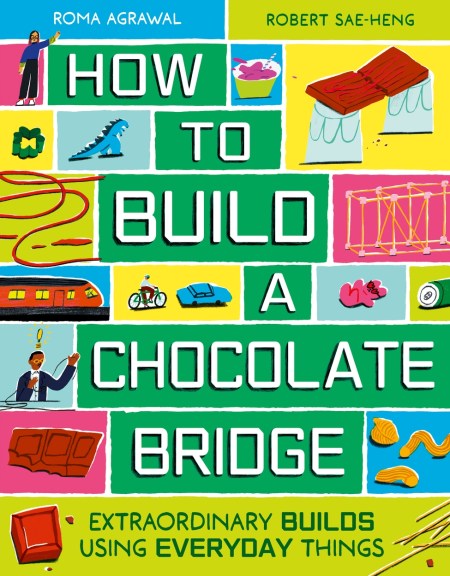
An interactive, hands-on exploration of science and the world around us, in a fantastically fun book for children aged 7+.
Can you make a skyscraper out of pasta? How about a rocket from meringue? As an engineer and a BIG fan of chocolate, Roma herself has often wondered whether a bridge could be made out of chocolate. This might sound impossible (and delicious), but you don’t know until you try…
With seven interactive building projects, kids will find out what is possible, while learning about the science behind awe-inspiring inventions. They will also get to meet some of the world’s most innovative scientists, who dare to experiment with wacky materials to create something great.
Written by bestselling author and award-winning engineer Roma Agrawal, this book encourages kids to put some unexpected materials to the test. It’s the perfect way to get kids excited about science – whilst having a WHOLE load of fun!
Can you make a skyscraper out of pasta? How about a rocket from meringue? As an engineer and a BIG fan of chocolate, Roma herself has often wondered whether a bridge could be made out of chocolate. This might sound impossible (and delicious), but you don’t know until you try…
With seven interactive building projects, kids will find out what is possible, while learning about the science behind awe-inspiring inventions. They will also get to meet some of the world’s most innovative scientists, who dare to experiment with wacky materials to create something great.
Written by bestselling author and award-winning engineer Roma Agrawal, this book encourages kids to put some unexpected materials to the test. It’s the perfect way to get kids excited about science – whilst having a WHOLE load of fun!
Reviews
I am a great believer in learning by doing, and this fantastic STEM-themed book not only has a title that will capture children's attention, but is filled with practical ideas to engage the learning of engineering principles. This is the second children's non-fiction title that I have read which has been authored by Roma Agrawal, and I love the way that this prize-winning structural engineer is able to make complex engineering accessible for anyone.
The book begins by describing why specific materials need to be chosen for manufacturing different products or for building certain structures. The author then explains the physics concepts behind engineering in child-friendly language, starting with bridge building. There is then a fascinating challenge set - to build a bridge with a chocolate bar, and after testing the strength of the bridge, children are then encouraged to reinforce melted chocolate with gummy laces, reflecting the way that concrete is reinforced with steel. I know that when my children were at primary school they worked on a bridge-building project as part of the science curriculum, and I imagine that this book will give teachers an exciting new perspective on teaching this topic. The engineering does not stop with bridges. Rockets, insulation, trumpets, pianos, bubbles, plastic and skyscrapers are all explored, both with facts and practical experiments which can be performed at school or in the home. There are also spreads covering scientists and engineers who made surprising or accidental discoveries and a look at materials being developed now to tackle challenges of the future, such as degradable plastics.
There are so many aspects of this book that I loved. Firstly, the information is presented in small accessible panels on full colour pages (where there is always a good contrast between text and background colours) and therefore easily digestible. The illustrations by Robert Sae-Heng are distinctive and always add to the understanding of the facts or principles being described. I loved the emphasis on learning from mistakes, which helps children to feel able to experiment freely, without the anxiety that they might get it wrong. I think that Roma Agrawal has an amazing ability to explain the principles of her complex profession in terms and with examples that can be understood by anyone.
How to Build a Chocolate Bridge is a book which I would recommend to teachers, librarians, parents and caregivers of all primary school children. With the long summer holidays approaching, there are ideas here for activities that could entertain and educate young brains, and perhaps inspire future scientists and engineers.